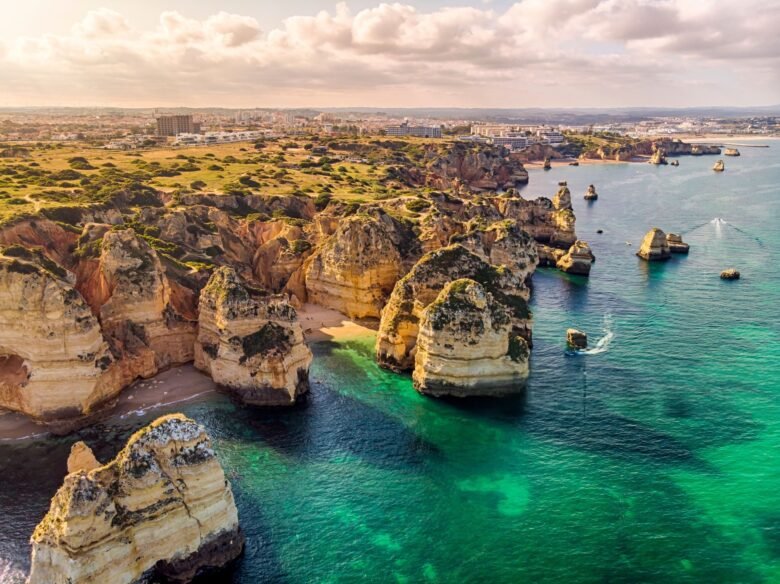
While many investors assume Portugal’s Algarve market is saturated, the reality tells a different story. Property prices in the region average €3,350-€3,600 per square meter with forecasts predicting 25-35% cumulative growth over five years. Short-term rentals generate €650-1,050 monthly net profit for well-managed properties, supported by consistent tourism demand. This article examines why 2026 presents a compelling opportunity for international investors seeking profitable holiday home investments in the Algarve, covering price trends, rental yields, regulatory requirements, and practical strategies for maximizing returns.
Inhaltsübersicht
- Key takeaways
- Understanding property prices and market growth in the Algarve
- Rental income potential: comparing long-term and short-term yields
- Navigating licensing, regulations, and purchase costs for 2026 investors
- Balancing risks and rewards: practical investing tips in Algarve real estate
- How Riva Prime consulting can help international investors
- FAQ
Wichtigste Erkenntnisse
| Punkt | Einzelheiten |
|---|---|
| Five year price growth | Prices average €3,350 to €3,600 per square meter, with forecasts for 25 to 35 percent cumulative growth over five years. |
| Rental yields overview | Gross yields average 4.7 percent across the region, with net yields around 3.1 percent after expenses. |
| Short term profits | Short term rentals can yield net profits of €650 to €1,050 per month for well managed properties, supported by strong tourism demand. |
| Tourism demand driver | The Algarve attracts over 5 million visitors annually, underpinning steady rental demand and income potential. |
| Location price spread | Prime Golden Triangle prices exceed €5,000 per square meter, while inland towns such as Portimão, Lagos, and Tavira offer about €2,800 to €3,500 per square meter, creating undervalued opportunities. |
Understanding property prices and market growth in the Algarve
The Algarve property market demonstrates consistent strength backed by fundamental supply constraints and robust tourism demand. Current property prices average €3,350-€3,600 per square meter across the region in early 2026, with significant variation between luxury coastal areas and emerging inland towns. Prime locations in the Golden Triangle (Quinta do Lago, Vale do Lobo, Vilamoura) command premium prices often exceeding €5,000/m², while towns like Portimão, Lagos, and Tavira offer more accessible entry points at €2,800-€3,500/m².
Market forecasts predict 4-7% growth in 2026 and 25-35% cumulative appreciation over the next five years. This growth trajectory stems from limited coastal development opportunities, strict environmental protections preventing oversupply, and sustained international buyer demand from UK, French, German, and increasingly American investors. The region’s 300+ days of annual sunshine, world-class golf courses, and improved flight connectivity from major European cities create enduring appeal that supports long-term value appreciation.
Scarcity drives the investment thesis. The Algarve coastline spans only 155 kilometers, with much of it protected as natural parks or already developed. New construction faces stringent approval processes, creating a supply-constrained market where quality properties appreciate faster than Portugal’s national average. Tourism fundamentals remain strong with over 5 million annual visitors, providing consistent rental demand that underpins both price growth and income potential.
Price trends by subregion (2026 forecasts):
| Location | Average Price/m² | 5-Year Growth Forecast | Investition Appell |
|---|---|---|---|
| Golden Triangle | €5,000-€7,500 | 20-25% | Premium luxury, lower yields |
| Lagos/Luz | €3,200-€4,000 | 28-33% | Strong rental demand, balanced |
| Portimão/Alvor | €2,800-€3,500 | 30-35% | Best value, high yields |
| Tavira/Eastern Algarve | €2,500-€3,200 | 32-38% | Emerging, growth potential |
| Faro City | €2,400-€3,000 | 25-30% | Urban rental market |
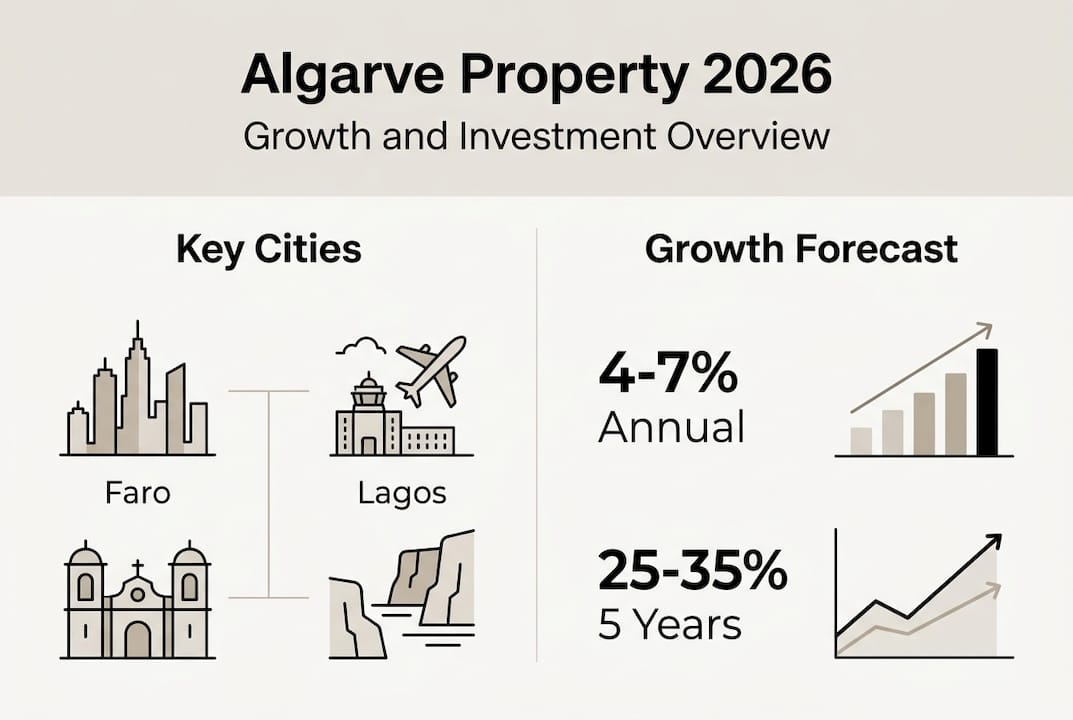
Investors seeking to evaluate Algarve real estate 2026 investments should focus on locations offering the optimal balance between current affordability and future appreciation potential. Towns within 15 minutes of major beaches or golf courses but priced 20-30% below prime coastal properties often deliver superior total returns when combining rental income and capital gains.
Pro Tip: Target undervalued locations near established tourism hubs rather than chasing premium addresses. Properties in Alvor, Luz, or Tavira currently offer 30-40% lower entry prices than Vilamoura or Albufeira while accessing the same tourist demand, positioning investors for stronger appreciation as the market matures.
Rental income potential: comparing long-term and short-term yields
Rental income forms the foundation of Algarve property investment returns, with yields varying significantly based on rental strategy and location selection. Gross rental yields average 4.7% across the region, ranging from 3.5-6.5% depending on property type and location, with net yields after expenses averaging 3.1%. This performance exceeds Portugal’s national average and compares favorably to other European coastal markets like Costa del Sol or French Riviera.

Long-term residential rentals provide stable, predictable income with minimal management burden. Properties in Portimão, Faro, and Olhão achieve the highest long-term yields at 5.5-6.5% gross, driven by strong local employment and university student demand. Mid-market towns like Lagos, Tavira, and Albufeira generate 4.5-5.5% yields. The luxury Golden Triangle delivers lower yields of 2.5-3.5% due to premium purchase prices, though capital appreciation potential offsets income limitations.
Short-term vacation rentals dramatically increase income potential for investors willing to accept higher management complexity. Well-run Airbnb properties average €180 per night with 55-62% annual occupancy rates, translating to €650-1,050 monthly net profit after management fees, utilities, cleaning, and maintenance costs. The Algarve hosts over 35,000 short-term rental listings, yet strong tourism fundamentals support healthy demand across most price segments.
Occupancy rates peak during summer months (July-September) at 85-95%, with shoulder seasons (April-June, October) maintaining 60-70% occupancy. Winter months (November-March) drop to 25-40% occupancy except during holiday weeks, requiring investors to budget for seasonal income fluctuations. Properties with heated pools, modern amenities, and professional photography consistently outperform market averages by 15-25% in both occupancy and nightly rates.
Long-term vs. short-term rental comparison:
| Rental Strategy | Gross Yield | Net Yield | Monthly Income (€300k property) | Management Effort | Risk Level |
|---|---|---|---|---|---|
| Long-Term Residential | 4.5-5.5% | 3.5-4.5% | €1,050-1,375 | Low | Low |
| Short-Term Vacation | 6.5-8.5% | 4.5-6.0% | €1,125-1,500 | High | Medium |
| Hybrid (9mo + 3mo) | 5.5-6.5% | 4.0-5.0% | €1,000-1,250 | Medium | Low |
Investors seeking to maximize rental returns Algarve 2026 must carefully evaluate the trade-offs between income potential and operational complexity. Short-term rentals require professional property management, regular maintenance, guest communication, and compliance with licensing requirements. Long-term rentals offer simplicity but sacrifice 30-40% of potential gross income.
Key factors influencing rental performance:
- Location proximity to beaches, golf courses, and tourist attractions
- Property condition, amenities, and modern furnishings
- Professional photography and dynamic pricing strategies
- Responsive guest communication and 5-star review management
- Seasonal marketing and promotional calendar optimization
Pro Tip: Calculate your break-even occupancy rate before committing to short-term rentals. Divide annual fixed costs (mortgage, property tax, insurance, HOA fees) by average nightly rate to determine minimum nights needed. If break-even exceeds 120 nights annually in your target location, long-term rental may deliver better risk-adjusted returns.
Navigating licensing, regulations, and purchase costs for 2026 investors
Regulatory compliance and upfront costs significantly impact investment returns, making thorough understanding essential for international buyers. Alojamento Local (AL) licensing is mandatory for all short-term rental properties in the Algarve, with recent reforms streamlining the process while granting municipalities greater control over new license issuance. Licenses issued after 2023 are now indefinite with no renewal requirements, transferable between property owners, and allow up to 9 rooms or 27 guests maximum.
Municipalities can limit new AL licenses in specific zones to prevent overtourism or preserve residential character, though existing licenses remain protected. Lagos, Albufeira, and Portimão have implemented selective restrictions in historic centers while encouraging licenses in newer developments. Buyers should verify AL license status before purchase, as properties without licenses face significant delays and uncertainty obtaining new approvals in restricted zones.
The licensing process requires property registration, tax compliance documentation, safety certifications, and municipal approval. Existing licenses transfer automatically with property ownership, making licensed properties more valuable. New license applications take 2-4 months in unrestricted areas, requiring architect plans, fire safety compliance, and energy certificates. Working with experienced legal counsel ensures smooth navigation of bureaucratic requirements.
International buyers face 6-10% closing costs when purchasing Algarve property, including 6% IMT property transfer tax (scaled by value), 0.8% stamp duty, 1-2% legal fees, and notary costs. Buyers must obtain a Portuguese tax number (NIF) before purchase, a straightforward process completed through lawyers or tax representatives. No ownership restrictions apply to EU or international buyers, though non-residents face slightly higher mortgage down payment requirements.
Mortgage financing is available to international buyers at 60-70% loan-to-value ratios with interest rates of 3.3-4.2% for 20-30 year terms. Portuguese banks require proof of income, tax returns, and existing debt obligations. Many investors opt for all-cash purchases to avoid currency risk and simplify transactions, particularly when leveraging property in their home countries.
Tax incentives remain available despite the 2023 Golden Visa program termination for real estate investments. The NHR 2.0 program offers reduced tax rates for qualifying high-value professionals and entrepreneurs relocating to Portugal, though real estate investment alone no longer qualifies. Rental income faces progressive taxation from 14.5-48%, with deductions available for mortgage interest, property management, maintenance, and depreciation.
Five key steps for international property buyers:
- Obtain Portuguese NIF tax number through lawyer or authorized representative (1-2 weeks)
- Secure mortgage pre-approval if financing, providing income documentation and credit history (3-4 weeks)
- Engage Portuguese lawyer for due diligence, title verification, and contract review (ongoing)
- Budget 8-12% total for closing costs, furnishings, and initial renovation if needed
- Verify AL license status and transferability before signing purchase contracts
Investors can review comprehensive foreign ownership rules Portugal 2026 guide resources to understand the complete legal framework. The Portuguese property buying process is straightforward and secure, with strong legal protections for foreign investors and transparent title registration systems.
Balancing risks and rewards: practical investing tips in Algarve real estate
Every investment carries risk, and Algarve property is no exception despite strong fundamentals. Contrasting views exist on market valuations, with bullish investors citing tourism growth and supply constraints while cautious observers warn of overpricing in prime Golden Triangle locations. Net yields below 4% in luxury areas raise questions about return adequacy relative to risk, though capital appreciation potential provides additional return components.
Area selection dramatically impacts investment success. Properties in established tourist zones with year-round appeal (Lagos, Albufeira, Vilamoura) deliver more consistent occupancy than remote rural locations dependent on summer-only demand. Proximity to beaches, golf courses, restaurants, and activities directly correlates with rental performance. Investors should visit target areas during off-season to assess realistic year-round appeal and local infrastructure quality.
Regulatory risk remains manageable but requires attention. While existing AL licenses enjoy strong legal protection, future municipal restrictions could limit property flexibility or reduce values in oversaturated zones. Diversifying across multiple properties or locations mitigates concentration risk. Investors should maintain flexibility to pivot between long-term and short-term rental strategies as market conditions evolve.
“Algarve rental yields consistently beat Portugal’s national average, but investors must look beyond gross returns to net profitability after management, maintenance, and vacancy costs. The most successful investors combine careful location selection with professional property management and realistic occupancy expectations.”
Property management quality directly determines rental success. Self-managing from abroad rarely works well, as guest issues, maintenance emergencies, and cleaning coordination require local presence. Professional management companies charge 15-25% of rental income but deliver superior occupancy, guest reviews, and property maintenance. The incremental cost pays for itself through higher rates and reduced vacancy.
Risk mitigation strategies:
- Focus on locations with strong year-round tourism fundamentals, not just summer appeal
- Budget conservatively using 50-55% occupancy projections, not optimistic 65-70% estimates
- Maintain 6-12 months operating reserve for major repairs, extended vacancies, or market downturns
- Work with licensed property managers who understand local regulations and guest expectations
- Consider hybrid rental strategies combining 9-month long-term tenants with 3-month vacation rentals
Pro Tip: Visit the Algarve during November or February to assess realistic off-season appeal. If the area feels dead or lacks open restaurants and activities, vacation rental occupancy will suffer. The best investment locations maintain vibrant local communities and amenities year-round, not just during peak tourist season.
Investors who understand why to invest in holiday rentals Algarve combine realistic expectations with professional execution consistently achieve strong risk-adjusted returns. The market rewards preparation, local knowledge, and quality property management while punishing speculative buying in marginal locations.
How Riva Prime consulting can help international investors
Navigating Algarve property investment from abroad requires local expertise, market knowledge, and operational support. Riva Prime specializes in helping international investors identify profitable holiday home opportunities, manage the purchase process, and maximize rental returns through professional property management. Our team understands the unique challenges foreign buyers face and provides end-to-end support from initial property search through ongoing rental operations.
Our investment consulting services help you evaluate properties based on realistic yield projections, location fundamentals, and total return potential. We analyze comparable rental data, assess renovation needs, verify AL licensing status, and provide transparent financial modeling. Many investors discover that investing in Algarve holiday homes with 4.7% yields delivers superior returns compared to their home markets while diversifying their portfolio internationally.
Professional property management in Lagos, Portugal transforms properties from occasional vacation homes into consistent income producers. Our services include guest communication, cleaning coordination, maintenance management, dynamic pricing optimization, and full financial reporting. We handle everything from check-ins to emergency repairs, allowing you to enjoy investment returns without operational headaches.
Ready to explore Algarve investment opportunities? Review our guide on steps to invest in Algarve real estate before prices rise further, and contact our team to discuss your investment goals and property requirements.
FAQ
What are the main costs involved in buying property in the Algarve?
Buyers should budget 6-10% of purchase price for closing costs, including 6% IMT property transfer tax, 0.8% stamp duty, and 1-2% for legal fees and notary services. International buyers need a Portuguese NIF tax number before purchase. If financing, expect 30-40% down payment with mortgage rates of 3.3-4.2% for 20-30 year terms at 60-70% LTV.
Can foreigners legally buy and rent out properties in Portugal?
Portugal imposes no ownership restrictions on EU or international buyers. You need only obtain a NIF tax number, which lawyers can arrange quickly. For short-term rentals, AL licensing is mandatory but the process is streamlined and licenses are now indefinite and transferable. Review complete foreign ownership rules Portugal 2026 guide for detailed requirements.
What is the typical rental income I can expect from a holiday home in the Algarve?
Well-managed short-term rentals generate €650-1,050 monthly net profit after all expenses, based on 55-62% annual occupancy at €180 average nightly rates. Performance varies significantly by location, property quality, and management effectiveness. Properties with professional management, modern amenities, and strong reviews consistently outperform market averages by 15-25%.
Are there any restrictions on renting properties short-term in 2026?
AL licenses are now indefinite with no renewal requirements and fully transferable between owners, with maximum capacity of 9 rooms or 27 guests. However, municipalities may limit new license issuance in specific zones to manage tourism density. Existing licenses remain protected, making licensed properties more valuable. Always verify license status before purchase in restricted municipalities.