Struggling to keep your Algarve vacation property booked during the off-season? You’re not alone. Many international investors face occupancy drops outside summer peaks, but smart strategies combining seasonal rental tactics, dynamic pricing, legal compliance, and professional management can transform your property into a steady income generator. This guide delivers expert-backed steps to optimize your Algarve rental income legally and effectively year-round, addressing seasonality, licensing complexities, and proven management practices that maximize returns.
Innehållsförteckning
- Prerequisites And Market Understanding
- Seasonal Occupancy Management
- Pricing Strategies And Rental Income Benchmarks
- Regulatory Compliance And Licensing
- Rental Strategy: Balancing Short And Long-Term Rentals
- Property Management Best Practices
- Common Mistakes And Troubleshooting
- Expected Results And Performance Benchmarks
- Maximize Your Algarve Rental Income With Riva Prime Consulting
- Vanliga frågor och svar
Key takeaways
| Punkt | Detaljer |
|---|---|
| Comply with Alojamento Local licensing | Portugal’s AL license is mandatory for short-term rentals, with recent reforms capping validity at 5 years and new CEAL tax from 2026. |
| Balance short and long-term rentals | Blend high-rate summer short-term lets with stable off-season longer stays to smooth income and reduce vacancy. |
| Apply dynamic pricing strategies | Adjust rates based on competitor analysis and booking velocity to avoid overpricing that kills occupancy. |
| Leverage professional management | Expert managers boost occupancy up to 15% through superior marketing, maintenance, and guest services. |
| Monitor performance metrics regularly | Track occupancy rates, guest reviews, and compliance status to refine strategies and maximize profitability. |
Prerequisites and market understanding
Before diving into optimization tactics, you need solid grounding in the Algarve rental market and legal landscape. The region’s tourism is highly seasonal, with demand concentrated in summer months when beaches and warm weather attract visitors from across Europe. Understanding this cyclical pattern is essential for planning your rental approach and setting realistic income expectations throughout the year.
Alojamento Local (AL) licensing is your legal gateway to short-term rentals in Portugal. This official permit is mandatory for any property rented short-term and comes with strict regulatory compliance requirements. Acquiring an AL license involves application fees, property inspections, and meeting safety standards, so factor these costs into your initial investment budget alongside acquisition price, transaction taxes, and setup expenses.
Property location and type dramatically influence your rental potential. Coastal properties in Lagos, Albufeira, or Vilamoura command higher rates and occupancy than inland rural homes. Apartments in tourist-friendly complexes with pools and amenities typically outperform standalone villas requiring more maintenance. Review our how to buy Algarve property investment guide for detailed property selection advice. Understanding these fundamentals prepares you to make informed decisions that align with your income goals and risk tolerance.
Seasonal occupancy management
The Algarve’s tourism calendar creates dramatic occupancy swings that directly impact your rental income. Peak season occupancy reaches about 74% in hotspots like Lagos during summer months, but annual averages hover near 65% as off-season bookings drop sharply. Managing these cycles requires active strategy, not passive hope that guests will magically appear year-round.
Marketing must shift with the seasons to capture different audience segments. Summer campaigns target families and beach holidaymakers through vacation rental platforms like Airbnb and Booking.com. Off-season efforts should pivot toward business travelers, digital nomads, and retirees seeking longer stays in milder climates. Each segment responds to different messaging, amenities, and pricing structures, so tailor your listings accordingly.
Combining short-term summer rentals with longer lets during shoulder and winter seasons creates income stability. A property sitting empty for four winter months destroys annual returns, but a three-month winter rental to a remote worker or retiree fills that gap with guaranteed income. This blended approach reduces vacancy risk while capturing peak summer rates when demand justifies nightly pricing.
Segmenting your target guests by season enhances booking rates. Summer attracts holidaymakers wanting beach access and family amenities. Spring and fall appeal to couples seeking quieter romantic getaways or cultural tours. Winter brings long-stay guests escaping northern Europe’s cold who value workspace, reliable internet, and local community access over tourist attractions. Understanding these preferences lets you adjust property descriptions, photos, and amenities to match seasonal demand.
Pro Tip: Use local booking data and guest demographic insights to refine your seasonal offers. Our Lisbon off season travel guide demonstrates how positioning properties for off-season travelers increases bookings, and similar tactics work in the Algarve when you emphasize mild winters, golf courses, and authentic Portuguese culture over beach activities.
Pricing strategies and rental income benchmarks
Setting competitive rental prices determines whether your property stays booked or sits empty. Average nightly rates in the Algarve vary dramatically by season, with summer commanding €150 to €250 per night for quality properties near beaches, while off-season rates drop to €50 to €100 as demand weakens. Understanding these benchmarks helps you price realistically rather than chasing unrealistic targets that scare away potential guests.

Dynamic pricing prevents the costly mistake of overpricing your rental. Overpricing leads to 20% slower booking velocity and lower occupancy compared to competitively priced properties in the Algarve. When your listing sits unbooked for weeks, you lose more revenue than if you had priced slightly lower and filled those dates immediately. Dynamic adjustment means monitoring booking pace and competitor rates weekly, then making small price changes to maintain steady reservations.
Major rental platforms charge commissions that reduce your net income, so factor these costs into your pricing strategy. Airbnb takes roughly 3% from hosts plus 14% from guests, while Booking.com charges hosts 15% to 18%. If you price without considering these fees, your actual earnings will disappoint. Calculate backwards from your desired net income to set rates that cover platform commissions, cleaning, utilities, and management while remaining competitive.
Follow this step-by-step pricing adjustment process to optimize income:
- Research competitor rates for similar properties in your area using rental platform search filters.
- Analyze your booking velocity over the past 30 days to identify if you’re priced too high or low.
- Review recent guest feedback for mentions of value perception, amenities, or pricing concerns.
- Adjust rates by 5% to 10% increments and monitor booking changes over two weeks before further tweaking.
- Set seasonal pricing tiers in advance, with higher summer rates and promotional off-season discounts to encourage early bookings.
| Season | Avg Nightly Rate | Occupancy Target | Platform Commission | Net Income (Est) |
|---|---|---|---|---|
| Summer | €150-€250 | 70-75% | 15-18% | €105-€210/night |
| Spring/Fall | €80-€140 | 55-65% | 15-18% | €55-€115/night |
| Winter | €50-€100 | 40-50% | 15-18% | €35-€80/night |
Pro Tip: Monitor booking velocity metrics in your property management software or rental platform dashboard. If your calendar shows less than 50% occupancy for dates 30 to 60 days out, drop prices immediately to capture bookings before competitors do. Speed matters more than holding out for higher rates that never materialize. Learn more about tracking performance with property management software Portugal tools that automate these insights.
Regulatory compliance and licensing
Portugal’s legal framework for short-term rentals centers on the Alojamento Local license, which you must obtain before accepting any bookings. This mandatory permit ensures your property meets safety, hygiene, and building code standards while registering you with tourism authorities. Operating without an AL license exposes you to heavy fines, forced closure, and potential legal battles with authorities or neighbors, making compliance your first priority before any rental activity begins.
Recent regulatory reforms have tightened AL licensing requirements to address housing availability concerns. New rules cap AL license validity at 5 years, after which you must reapply and meet updated standards. This time limit creates renewal uncertainty, especially if regulations continue evolving. The 5-year cap means you cannot assume indefinite rental rights and must stay informed about policy changes that could affect your license renewal prospects.
The new CEAL tax applies specifically to short-term rental income starting in 2026, adding another cost layer to your operations. This tourism accommodation tax varies by municipality and property type, typically ranging from €1 to €2 per guest per night. While seemingly small, CEAL tax accumulates quickly on high-turnover properties and must be collected from guests, tracked accurately, and remitted to authorities on schedule. Failure to comply invites penalties and audit risks.
Neighbor voting rights now influence AL license decisions in multi-unit buildings, giving residents veto power over new licenses or renewals in some circumstances. If neighbors complain about noise, excessive guest turnover, or building wear from rental activity, they can block your license. This rule makes maintaining good neighbor relations essential, requiring you to enforce quiet hours, manage guest behavior, and address concerns promptly to protect your rental business.
Penalties for non-compliance escalate quickly and can destroy your investment returns. Fines for operating without an AL license start at €2,000 and climb to €10,000 or more for repeat violations. Authorities can revoke existing licenses for serious infractions like safety violations or tax evasion, forcing immediate rental cessation. Beyond fines, unlicensed rentals face civil liability if guest injuries occur, creating devastating financial exposure. Compliance is not optional; it’s the foundation of sustainable rental income. Review our rental income taxation Portugal 2026 guide for comprehensive tax obligations beyond AL licensing.
Rental strategy: balancing short and long-term rentals
Blending short-term and longer-term rental approaches creates income stability while maximizing your property’s earning potential across all seasons. Short-term vacation rentals yield higher nightly rates during peak demand but face occupancy gaps, regulatory complexity, and higher management costs. Longer-term rentals to monthly or seasonal tenants provide guaranteed income with fewer legal restrictions but generate lower overall revenue per night. The winning strategy combines both modes strategically based on seasonal demand patterns.
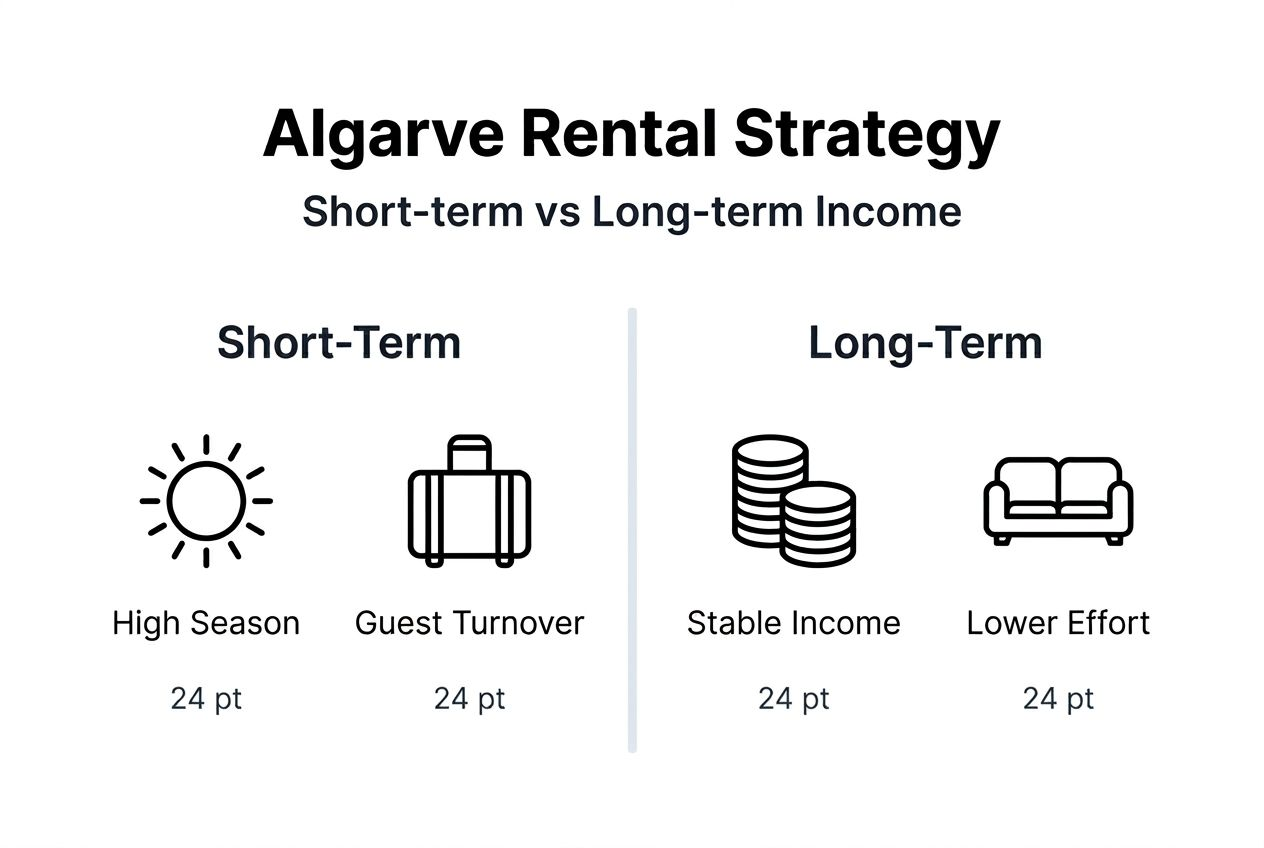
Short-term rentals excel during high season when tourist demand justifies premium nightly rates. A well-located Algarve property can earn €150 to €250 per night in summer, generating substantial income if you maintain 70% occupancy through July and August. However, short-term rentals require constant guest turnover management, cleaning between stays, platform listing optimization, and AL license compliance. This intensity demands either significant personal time investment or professional property management support.
Longer-term rentals offer consistent occupancy with minimal turnover during off-season months when short-term demand weakens. Renting your property for three to six months to a digital nomad, retiree, or business traveler guarantees income without the uncertainty of nightly bookings. Long-term tenants face fewer regulatory restrictions, require less frequent cleaning, and reduce wear from constant guest changes. However, monthly rates typically convert to lower nightly equivalents than peak summer short-term pricing.
| Factor | Korttidsuthyrning | Långtidsuthyrning |
|---|---|---|
| Income Potential | High per night (€150-€250 summer) | Moderate per month (€800-€1,500) |
| Occupancy Stability | Variable, seasonal gaps | Stable, guaranteed periods |
| Regulatory Requirements | AL license, CEAL tax, strict compliance | Simpler, standard tenancy rules |
| Management Effort | High, constant turnover | Low, minimal interaction |
| Seasonal Best Fit | Peak summer months | Off-season/shoulder periods |
Seasonal switching between rental types optimizes returns while minimizing vacancy. Operate as a short-term vacation rental from May through September when tourist demand peaks, then transition to a three- or four-month winter rental from November through February. This hybrid approach captures high summer rates while avoiding empty winter months that drain your annual returns. Spring and fall shoulder seasons offer flexibility to test either strategy based on booking momentum. Explore our what is short term letting Algarve guide for detailed implementation tactics.
Property management best practices
Strong property management directly determines your rental income, occupancy rates, and guest satisfaction scores. Even the best-located property with competitive pricing will underperform if management is sloppy, slow, or unprofessional. Consistent cleaning, proactive maintenance, efficient guest communication, and responsive problem-solving separate successful rentals from disappointed investments that drain money instead of generating it.
Regular cleaning and preventative maintenance keep your property attractive, functional, and guest-ready. Schedule deep cleaning between every guest stay, including linens, bathrooms, kitchens, and all living areas. Inspect for damage, missing items, or maintenance issues after each checkout so you can address problems before the next arrival. Preventative upkeep like HVAC servicing, pool cleaning, and garden maintenance prevents expensive emergency repairs while ensuring guests enjoy the quality they paid for.
Efficient, friendly guest check-in and checkout processes create positive first and last impressions that drive reviews and repeat bookings. Provide clear arrival instructions with parking details, door codes, and welcome materials explaining house rules, WiFi passwords, and local recommendations. Be available via phone or messaging to handle questions promptly. Smooth checkout with simple instructions and gracious thank-you messages encourages guests to leave positive reviews and recommend your property to friends.
Professional property managers boost occupancy significantly through superior marketing, guest services, and operational efficiency. Experienced managers know local market dynamics, maintain optimized listings across multiple platforms, respond to inquiries faster than solo owners, and handle problems professionally. Studies show professional management can increase occupancy by up to 15% compared to owner-managed properties, more than offsetting management fees through higher revenue and fewer costly mistakes.
Property management software enhances efficiency and reporting accuracy by centralizing reservations, guest communication, cleaning schedules, and financial tracking. Modern platforms automate booking confirmations, payment collection, review requests, and maintenance alerts, reducing manual work while minimizing errors. Detailed financial reports let you track income, expenses, and performance metrics in real time, enabling data-driven decisions that optimize your returns.
Pro Tip: Outsource guest communication to local bilingual property managers who speak English, Portuguese, and other European languages fluently. Language barriers create frustration and negative reviews when international guests cannot get timely answers to questions. Local managers also handle emergencies faster with established vendor relationships for repairs, lockouts, or maintenance issues. Learn more about these benefits in our advantages of property management Portugal investors guide.
Common mistakes and troubleshooting
Avoiding frequent investor errors protects your rental income and prevents costly setbacks that undermine profitability. Many international investors stumble into predictable traps, from ignoring legal requirements to poor pricing decisions, that damage their returns. Learning from others’ mistakes helps you sidestep these pitfalls and maintain smooth, profitable operations from the start.
Ignoring AL licensing requirements is the most dangerous mistake you can make. Some investors rationalize operating without a license to avoid fees or complexity, hoping authorities won’t notice. This gamble risks fines starting at €2,000, forced rental closure, legal disputes, and reputational damage that makes future licensing nearly impossible. Always obtain proper licenses before accepting bookings, and renew promptly to maintain uninterrupted operations.
Overpricing your property guarantees vacancy and revenue losses that compound throughout the season. Investors emotionally attached to their properties or chasing unrealistic return projections set rates above market levels, then watch their calendars stay empty while competitors book solid. Ego-driven pricing costs more than swallowing pride and matching market rates. Use objective data from comparable properties, not wishful thinking, to set competitive rates that actually generate bookings.
Failing to anticipate seasonality leaves properties empty during predictable off-season months, destroying annual returns. Investors who plan only for summer success ignore the reality that 50% to 60% of the year brings weak demand. Without strategies like longer-term winter rentals or aggressive off-season marketing, properties sit vacant earning zero income while still incurring mortgage, utility, and maintenance costs. Plan for the full 12-month cycle, not just the easy summer months.
Neglecting maintenance reduces guest satisfaction, triggers negative reviews, and kills future bookings. Deferred upkeep creates a downward spiral where poor reviews lower your search ranking, fewer bookings reduce income, and declining condition drives remaining guests to complain more. Regular maintenance preserves property value, keeps guests happy, and protects your online reputation, which is your most valuable marketing asset.
For more perspective on common pitfalls, review our Lisbon travel mistakes guide, which highlights similar errors travelers and property owners make that diminish experiences and outcomes.
Expected results and performance benchmarks
Setting realistic expectations about rental income timelines and performance helps you measure success and stay committed through the learning curve every new investor faces. Most Algarve rental properties reach positive net income within one to two years of operation, assuming proper licensing, competitive pricing, and active management. This timeline reflects the ramp-up period needed to build guest reviews, optimize listings, refine pricing, and establish efficient operational routines.
Successful properties achieve average annual occupancy rates of 65% or higher across all seasons. Top performers in prime locations hit 70% to 75% by combining strong summer bookings with effective off-season strategies. These benchmarks separate profitable investments from marginal ones that struggle to cover costs. If your occupancy consistently falls below 60%, diagnose whether pricing, property condition, location, or management is the weak link holding you back.
Return on investment depends on balancing seasonal occupancy rates, pricing discipline, and cost control. A well-managed property in a good Algarve location can generate 5% to 8% net rental yield annually after all expenses, taxes, and management fees. Properties in premium areas like Lagos or Vilamoura may achieve higher yields, while rural or less tourist-friendly locations struggle to break 4%. Your ROI timeline also factors in capital appreciation, which historically adds 3% to 5% annually in desirable Algarve markets.
Key performance indicators to track include occupancy rate trends, average daily rate, guest review scores, booking lead times, and repeat guest percentage. Improving occupancy and reviews signals your strategies are working. Declining metrics warn you to adjust pricing, upgrade amenities, or enhance management before losses accumulate.
| Benchmark | Target Range | Timeline to Achieve |
|---|---|---|
| Annual Occupancy Rate | 65-75% | 12-18 months |
| Net Rental Yield | 5-8% | 18-24 months |
| Guest Review Score | 4.5+ stars | 6-12 months |
| Repeat Guest Rate | 15-25% | 18-24 months |
| Positive Net Income | Break-even to +10% | 12-24 months |
Maximize your Algarve rental income with Riva Prime Consulting
Optimizing your Algarve rental income requires expertise in local regulations, market dynamics, and professional management practices you’ve learned throughout this guide. Riva Prime offers comprehensive property management services that address licensing, marketing, maintenance, and guest services, removing the complexity and time burden from international investors. Our local presence in Lagos gives you on-the-ground advantage navigating Portugal’s evolving rental regulations while maximizing occupancy through proven strategies.
We provide end-to-end support from property acquisition advice through Algarve property investment guide resources to dynamic pricing and guest management that keeps your property booked year-round. Our team handles AL licensing, CEAL tax compliance, seasonal rental transitions, and all operational details while you enjoy passive income from your investment. Learn why smart investors choose our property management in Lagos Portugal services and explore the full property management advantages Portugal investors gain by partnering with local experts who protect and grow your returns.
Frequently asked questions
What is the Alojamento Local (AL) license and why is it important?
The AL license is the official permit required to legally rent properties short-term in Portugal. Operating without it risks fines from €2,000 to €10,000 and forced rental closure. This license ensures your property meets safety standards and registers you with tourism authorities, protecting both your investment and guests.
How can I balance seasonal demand in the Algarve?
Use short-term vacation rentals during summer peak season to capture premium nightly rates, then switch to mid-to-long term rentals during off-season months. This blended approach smooths income throughout the year and improves overall occupancy rates while reducing vacancy gaps that kill annual returns.
What mistakes should I avoid to optimize rental income?
Avoid ignoring AL licensing requirements, overpricing your property, neglecting maintenance, and failing to plan for seasonal occupancy fluctuations. Each mistake triggers cascading problems from fines and vacancy to poor reviews and declining income. Regularly review your strategies, comply with all regulations, and adjust pricing based on booking data to maintain profitability.
How long until I see positive rental income from my Algarve property?
Most investors achieve positive net rental income within one to two years of operation, assuming proper licensing, competitive pricing, and active management. Performance depends on maintaining 65% or higher occupancy rates, controlling expenses, and staying compliant with Portuguese rental regulations. Properties in prime locations with professional management reach profitability faster than owner-managed rural properties.