Many European investors dream of owning a sun-soaked retreat in Algarve while gaining residency through Portugal’s highly regarded Golden Visa. The appeal lies in combining legal status, access to public services, and seamless travel freedom throughout the EU, all by making a financial investment. However, with recent program updates removing real estate as a qualifying route, understanding the new pathways and how they affect property investment is more critical than ever for those seeking both ease and profit in their Portuguese journey. For those looking to balance lifestyle and investment, expert financial and legal support is now essential.
Table of Contents
- Golden Visa Portugal – Core Principles
- Current Investment Routes and Eligibility
- Legal Requirements and Application Steps
- Residency, Family, and Travel Benefits
- Costs, Risks, and Common Pitfalls
- Latest Changes and Future Outlook
Key Takeaways
| Point | Details |
|---|---|
| Golden Visa Overview | The Golden Visa Portugal offers residency through investment starting at €250,000, granting access to public services and enabling visa-free travel across the EU. |
| Investment Pathways | As of October 2023, real estate is no longer a qualifying route; new pathways include venture capital funds, cultural contributions, job creation, and company capitalization. |
| Eligibility Criteria | Only non-EU, non-EEA, and non-Swiss nationals can apply, requiring clean criminal records and documented sources of investment capital. |
| Family Inclusion Benefits | The program allows inclusion of family members under a single application, granting them residency rights and access to public services simultaneously. |
Golden Visa Portugal – Core Principles
The Golden Visa Portugal is a residence permit designed for investors willing to make significant economic contributions to the country. At its foundation, the program offers something straightforward: legal residency in Portugal in exchange for investment, with minimum investment starting at €250,000. This isn’t about temporary tourism or work permits. You’re acquiring official resident status that grants you access to Portuguese public services, healthcare, and education systems on equal footing with Portuguese citizens. The permit arrives with two-year validity and automatic renewal eligibility, giving you genuine stability rather than year-to-year uncertainty.
What makes this program particularly attractive for European investors is its flexibility combined with its practical benefits. When you hold a Golden Visa, you gain visa-free travel across the entire EU, something most European citizens already enjoy but now without the limitations of temporary tourist visas. More importantly, the program has no strict residency requirements, meaning you don’t need to spend a certain number of days in Portugal annually to maintain your status. For someone balancing business interests across multiple EU countries, this matters enormously. You can keep your primary residence in your home country while maintaining Portuguese residency for tax benefits, investment purposes, and long-term family planning.
The timeline from application to approval typically runs between 6 to 18 months, depending on your chosen investment route and how quickly you complete required documentation and bureaucratic procedures. The investment itself comes through several pathways: real estate purchases (the most popular route for property-focused investors), business creation, or capital transfer. For EU investors seeking Algarve property investments, the real estate route has proven most accessible and transparent. Since the program launched in 2012, it has attracted over 12,000 primary applicants and generated more than €7 billion in total investment inflows, demonstrating both its legitimacy and its appeal across the European investment community.
One feature that sets Portugal’s program apart from comparable European residency schemes is the pathway to citizenship. After five years of holding a Golden Visa, you become eligible to apply for Portuguese citizenship without needing to maintain full-time residency during that period. This means you could hold residence permits while living elsewhere, then convert to citizenship status with genuine European integration. Your family members can also benefit from the visa, allowing spouses and dependent children to gain residency rights under your primary application. This multi-generational advantage transforms the investment from a personal wealth decision into a family positioning strategy.
Pro-Tip: Start your investment documentation at least three months before applying, as property valuations, bank statements, and legal certifications for residency applications require time to compile accurately. Working with specialists familiar with Portuguese administrative requirements reduces delays significantly.
Current Investment Routes and Eligibility
Here’s what changed recently and what it means for you. As of October 2023, Portugal’s Golden Visa program underwent a significant restructuring that eliminated real estate investment as a qualifying route. This shift surprised many investors who had targeted Portuguese property acquisitions as their pathway to residency. However, the program expanded in other directions, creating five primary investment routes designed to channel capital into areas Portugal prioritizes for economic development. Understanding which route aligns with your financial position and investment appetite is critical before you commit time and resources to an application.
The Five Investment Pathways
The most straightforward routes for capital investors involve venture capital or private equity. You can invest €500,000 in CMVM-registered venture capital or private equity funds that target Portuguese businesses. This approach works well if you have liquid capital sitting in investment accounts and want to diversify your portfolio while securing residency. Alternatively, cultural and scientific contributions offer lower entry points. Donating €250,000 to cultural heritage projects qualifies you, with reduced requirements of €200,000 in low-density areas outside major urban centers. Scientific research donations start at €500,000 but appeal to investors with philanthropic interests aligned with Portuguese academic development.

For those with business acumen rather than passive capital, job creation provides another pathway. You must create employment for at least 10 full-time workers through a Portuguese business venture. This requires more operational involvement than passive investment routes but often generates ongoing returns through business operations. Similarly, business capitalization allows you to incorporate a company in Portugal with sufficient capital reserves to maintain or create jobs. This route appeals to entrepreneurs planning to establish meaningful commercial operations in the country beyond the residency investment itself.
Here’s a summary of the five investment pathways under Portugal’s Golden Visa program:
| Pathway | Minimum Investment | Business Involvement | Key Advantage |
|---|---|---|---|
| Venture Capital/PE Fund | €500,000 | None (passive investment) | Diversifies portfolio, supports startups |
| Cultural Heritage | €250,000–€200,000 | Minimal, donation-based | Lower threshold in low-density areas |
| Scientific Research | €500,000 | Minimal, donation-based | Supports academic and research institutions |
| Job Creation | Operational costs | High (active business role) | Direct impact, ongoing management |
| Company Capitalization | Varies | High (entrepreneur-led) | Business ownership, job creation |
Eligibility Requirements and Important Restrictions
One critical factor shapes eligibility for all routes: your citizenship status determines access to the program. The Golden Visa explicitly requires applicants to be non-EU, non-EEA, and non-Swiss nationals. This represents a significant restriction for your target audience of European Union citizens. If you hold an EU passport, you already possess freedom of movement across Portugal and all EU member states under EU law. The Golden Visa program was never designed for existing EU citizens who already enjoy residency and work rights throughout the union.
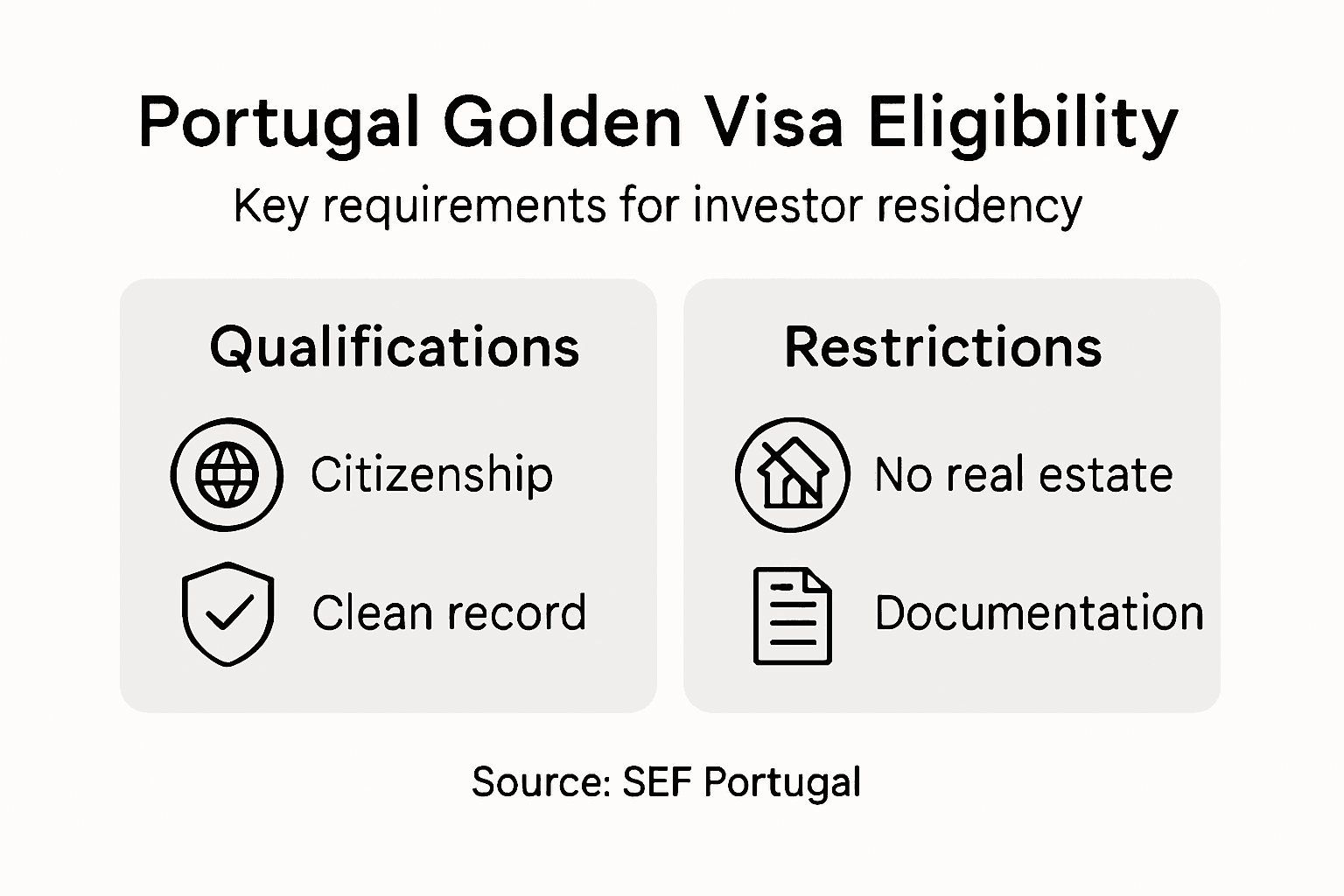
Beyond citizenship requirements, all applicants must demonstrate clean criminal records with supporting documentation from law enforcement authorities in their home countries. You’ll also need to prove financial compliance and legitimate sources of investment capital. Documentation requirements are substantial and include proof of funds, business plans (for entrepreneurship routes), and professional valuations for cultural or scientific contributions. The application process itself demands precision, as incomplete submissions trigger delays or rejections that can push your timeline back by months.
The elimination of real estate investment fundamentally changes the program’s appeal for property focused investors. If acquiring a Portuguese property was your primary motivation for exploring residency options, the Golden Visa no longer offers that direct pathway. However, alternative approaches exist for real estate investors seeking long-term Portuguese connections. Some investors pursue residency through other visa categories while independently purchasing property for rental income or personal use. Others use business creation routes to establish property management companies that support their real estate investments, creating the requisite job creation component simultaneously.
Pro-Tip: If you’re an EU citizen seeking Portuguese residency primarily for property investment and lifestyle, consult with legal specialists about alternative visa pathways like the D7 passive income visa or long-term residency permits, as these often better suit European investors than the Golden Visa route now requires.
Legal Requirements and Application Steps
Before proceeding, understand that the application process described here applies only to non-EU, non-EEA, and non-Swiss nationals. As established in the previous section, EU citizens like most of your target audience cannot legally apply for Portugal’s Golden Visa program. However, understanding these steps proves valuable for family members from outside Europe, business partners, or for those considering other residency pathways that might work better for European investors. The procedural requirements remain consistent and transparent, which is why exploring them offers insight into how Portugal structures its investment immigration framework.
The application journey begins with document preparation, which takes longer than most investors anticipate. You’ll need to gather digital documents including valid passports, criminal record certificates, and proof of investment. Criminal records must be obtained from both your country of residence and country of origin, then officially apostilled and translated into Portuguese. This dual certification adds weeks to your timeline because government offices move slowly, and professional translation services need time to work through the paperwork. Simultaneously, you must compile proof of your investment through fund subscription agreements, business registration documents, or donation commitments, depending on which route you selected. Bank statements demonstrating legitimate source of funds become critical documentation at this stage.
The Digital Application Process
Once your documents are prepared and translated, you’ll work through Portugal’s centralized immigration authority system. The process requires opening a Portuguese bank account and applying through AIMA’s digital portal, which handles all residence permit applications. You’ll need a Portuguese tax identification number (NIF), which the bank helps you obtain during account setup. Submitting through AIMA’s online system means everything happens digitally except for one critical step: biometric data collection.
After your initial submission receives approval in principle, the system automatically schedules biometric appointments at designated locations. You must attend in person to have your fingerprints and photograph recorded. This cannot be done remotely or delegated, so you’ll need to travel to Portugal for this appointment unless you use an authorized representative to collect your biometric data at a Portuguese consulate in your home country. Following successful biometric processing and final compliance verification, you receive your two-year residence permit. This entire process from submission to residence permit issuance typically requires 6 to 18 months, depending on document completeness and AIMA workload.
Renewal and Long-Term Status Pathways
Your first residence permit lasts two years, after which renewal becomes necessary. Renewals require compliance verification, meaning authorities review whether you maintained your investment commitment and met any residency obligations tied to your specific investment route. After five years of holding a valid residence permit, you become eligible for permanent residency status or Portuguese citizenship application, provided you meet additional requirements like basic Portuguese language proficiency.
The documentation requirements throughout this process emphasize legitimacy and transparency. Portugal’s authorities scrutinize source of funds extensively because they aim to prevent money laundering and ensure genuine investment capital enters the economy. Bank statements must clearly trace money movement. Investment fund subscriptions must show actual capital deployment. Business creation routes require detailed business plans with financial projections. Authorities want to see real economic activity and genuine wealth, not shell transactions designed purely for residency acquisition.
Pro-Tip: Engage a Portuguese legal specialist at least four months before planning to submit your application; they’ll ensure all documents meet AIMA standards, handle translation coordination, and prevent costly rejections from administrative errors that could delay your approval by half a year.
Residency, Family, and Travel Benefits
Once approved, your Golden Visa opens doors that extend far beyond personal residency. You gain full access to Portuguese society as a legal resident, which means enrollment in public healthcare systems, education opportunities for your children, and unrestricted labor market participation. This isn’t temporary tourist status or a business visa with limitations. You’re treated as a resident for legal and administrative purposes, which changes everything about how you can structure your life in Portugal. But the real power of this program lies in how it extends to your family members, creating multi-generational benefits from a single investment.
Family Inclusion and Dependent Coverage
The Golden Visa program allows you to include spouses, minor children, and adult dependents under your single application. This family inclusion means everyone benefits from the residency grant simultaneously, not as separate applicants with separate costs. Your spouse gains the same residency rights, healthcare access, and employment permissions as the primary applicant. Minor children automatically qualify without additional investment, and adult dependents who rely on you financially can be included in most cases. Some programs even extend coverage to parents, creating genuine multi-generational family relocation possibilities. This structure proves particularly valuable for investors concerned about education continuity for children or supporting aging parents in a safe European environment.
Consider the practical implications. Your teenager attends Portuguese schools as a legal resident, accessing the same educational system as Portuguese citizens. Your spouse can work for Portuguese employers without work permit complications. Your adult child studying at a Portuguese university gains residency status automatically. These aren’t benefits granted to tourists or temporary residents. You’re all positioned as permanent members of Portuguese society from day one of approval.
Schengen Travel Freedom and EU Mobility
Here’s where the program delivers exceptional value for European location strategy. Golden Visa holders and their family members gain unrestricted Schengen Area access across 27 countries, eliminating visa requirements for travel throughout continental Europe. This matters more than it sounds at first glance. You can move between Portugal, France, Germany, Spain, Italy, Austria, and 21 other countries without border checks or documentation hassles. Business meetings in Barcelona, weekend trips to Rome, conferences in Vienna, family visits across the continent, all happen without visa paperwork or entry delays.
For someone balancing European business interests, this mobility proves transformative. You’re not restricted to staying in one country or managing multiple visa categories for different destinations. You’ve secured a Schengen residency base that enables fluid movement across the entire developed European region. The practical advantage compounds when you consider family travel. Your entire family moves with the same freedom, whether it’s seasonal tourism, business travel, or relocation between European residences.
Pathways to Permanent Status and Citizenship
Your initial two-year residence permit represents the beginning rather than the end of your Portugal residency journey. After five years of maintaining your Golden Visa status and meeting any investment requirements tied to your specific route, you become eligible to apply for permanent residency or citizenship status with dual nationality allowed. Portuguese citizenship opens additional possibilities, including EU political participation, simplified inheritance laws, and generational wealth structuring advantages.
The five-year pathway to citizenship offers something unique compared to other European residence programs. You’re not required to maintain full-time residency throughout those years. You can live primarily in your home country while maintaining your Portuguese investment commitment. Then, after establishing permanent residency or citizenship, you’ve created a genuine European legal foundation that transcends any single country’s immigration policies. Your children born during this period can claim Portuguese citizenship at birth. Your spouse can pursue citizenship independently once residency requirements are met. Your entire family structure gains European citizenship optionality.
Pro-Tip: If family multi-generational benefits matter to your long-term strategy, document all dependents carefully during the initial application to ensure spouses and qualifying adult children secure residency simultaneously, avoiding costly separate applications years later.
Costs, Risks, and Common Pitfalls
Let’s talk about money and what can go wrong. The Golden Visa requires substantial financial commitment beyond the headline investment amount you hear advertised. Most investors focus on the minimum investment figure, €250,000 to €500,000 depending on your chosen route, then get surprised by layers of additional costs they didn’t anticipate. Government fees range from approximately €600 for application submission to €6,000 for residence permit issuance per person, which adds up quickly when you’re including family members. Legal fees typically run €15,000 to €20,000 over the five-year visa period. Fund subscription charges, bank account setup fees, health insurance requirements, and translation services all accumulate. When you add everything together, your actual cost of entry can be 20 to 30 percent higher than the base investment figure alone.
Underestimating total financial commitment represents the first major mistake. Applicants calculate the minimum investment and government fees, then proceed without accounting for legal representation costs, which prove absolutely essential despite the expense. A qualified Portuguese immigration lawyer isn’t optional if you want to avoid costly rejections or delays. They handle document apostille coordination, translation verification, and submission compliance. They also manage communication with authorities throughout your processing timeline. Trying to save money by handling this yourself typically costs more through rejection fees and resubmission requirements. Budget conservatively and plan for the full five-year cycle, not just the initial approval phase.
Compare the main costs and hidden financial aspects involved in the Golden Visa:
| Expense Type | Typical Cost Range | Applies to Applicants | Unique Note |
|---|---|---|---|
| Government Fees | €600–€6,000 | Per person | Increases with family members |
| Legal Representation | €15,000–€20,000 | Per application | Essential for success |
| Compliance/Management | €3,000–€5,000 | Over five years | Ensures ongoing eligibility |
| Translation/Doc Fees | €1,000–€3,000 | Per application | Varies by document volume |
Documentation and Administrative Pitfalls
The second danger zone involves documentation failures that trigger rejections. Common mistakes include incomplete or improperly apostilled documentation, delayed or missed biometric appointments, and lack of proof of sustained investment. Each of these seems manageable until you experience it. Criminal record certificates must be apostilled by the correct authority in your home country, not just any government office. The apostille itself requires official authentication of the certifying official’s signature. Translations must be completed by officially recognized translators in Portugal. Missing these details doesn’t result in a quick correction. Instead, you receive a rejection notice requiring complete resubmission, adding four to eight months to your timeline.
Biometric appointments matter more than many applicants initially understand. The system automatically schedules these appointments, and missing one cancels your entire application without refund. You cannot reschedule missed appointments at your discretion. The appointment must be attended in person at a designated location, or you must arrange biometric collection at a Portuguese consulate in your home country. Applicants traveling internationally sometimes miss notices sent to temporary addresses. Others assume they can reschedule like typical government services. Both assumptions prove incorrect and result in application termination. You restart from the beginning with zero credit for previous processing time.
Investment Compliance and Renewal Risks
Beyond initial approval, sustained investment compliance becomes your ongoing obligation. Your investment must remain in place throughout your residence permit validity period. Withdrawing funds prematurely or liquidating your investment before permit renewal violates program requirements and can trigger deportation proceedings. The specific compliance requirements vary by investment route. If you subscribed to venture capital funds, those funds must remain invested. If you established a business for job creation, you must maintain the required employment level. Failure to prove sustained investment during renewal appointments results in application denial. You lose your residency status and must exit Portugal.
Renewal applications require proof that your investment remains active and compliant. Bank statements documenting continued fund holdings, employment records for job creation routes, and ongoing fund management statements all become necessary documentation. Applicants sometimes assume renewal is automatic or merely administrative. It’s not. Portuguese authorities conduct full compliance review during renewals. They verify your investment continues, check employment records, and confirm you haven’t violated program terms. Starting five years into your residence arrangement, you cannot afford compliance failures. Plan for professional assistance managing your investment documentation and renewal requirements.
Risk Mitigation Through Professional Support
The pathway through these challenges involves engaging qualified professionals from the beginning. Legal specialists familiar with Golden Visa requirements catch documentation errors before submission. They identify apostille requirements specific to your country, arrange authorized translations, and manage AIMA communication. Tax advisors ensure your investment structure doesn’t create unexpected Portuguese tax complications. Immigration specialists track renewal deadlines and prepare compliance documentation in advance. This professional network costs money upfront but prevents far more expensive failures later.
Pro-Tip: Allocate an additional €3,000 to €5,000 in your budget specifically for ongoing compliance documentation and renewal management over five years, as handling these requirements independently typically results in costly errors that threaten your entire residence permit.
Latest Changes and Future Outlook
Portugal’s Golden Visa program didn’t stay static. The October 2023 restructuring marked a deliberate policy shift reflecting Portugal’s evolving economic priorities and European sustainability goals. Real estate investment, which previously dominated the program, disappeared completely from qualifying routes. This change surprised many property investors who assumed real estate would remain the easiest pathway forever. But Portugal’s government recognized that unlimited real estate investment was driving housing costs upward, pricing Portuguese citizens out of their own market. The solution involved shifting the program to exclude real estate investments completely while promoting sustainable economic growth through regulated fund subscriptions, job creation, and cultural investments. This restructuring represents more than minor adjustment. It fundamentally repositioned the program’s purpose from attracting capital for property development toward channeling investment into entrepreneurship, research, and cultural preservation.
Understanding the Policy Shift and Grandfathering Protections
The timing of these changes matters significantly for existing investors and future applicants. Portugal implemented the changes gradually to protect prior applicants through grandfathering clauses, ensuring individuals who submitted applications before October 2023 could complete processing under the original rules. This protection prevented the policy shift from retroactively eliminating already-pending applications. However, new applicants faced the reality immediately. If you submitted after October 2023, real estate investment no longer qualifies regardless of purchase price or location. This explains why some individuals accelerated their timelines in late 2023, racing to submit applications before the deadline.
The policy transition also reflects broader European trends toward sustainability and strategic investment. EU member states increasingly scrutinize residence-by-investment programs to ensure they contribute meaningfully to economic development rather than simply channeling foreign capital into property speculation. Portugal’s adjustment positions the program as focused on genuine economic contribution. Venture capital investments create entrepreneurial ecosystems. Job creation routes support employment and business development. Scientific research donations advance academic institutions. Cultural heritage investments preserve Portuguese historical sites. Each route channels capital toward outcomes Portugal explicitly values.
Competitive Position and Program Stability
Despite the restructuring, Portugal’s Golden Visa remains competitive as one of Europe’s few residency schemes requiring minimal physical presence and offering a fast citizenship track. Compare this to other European residence programs. Many countries require extensive minimum stay periods, forcing investors to spend 90 to 180 days annually in the country. Portugal’s low residency requirements mean you can live primarily elsewhere while maintaining your residence status. This flexibility proves particularly valuable for investors with business interests across multiple European countries. Additionally, Portugal’s five-year citizenship pathway accelerates your access to full EU citizenship compared to most comparable programs.
The digital transformation of the application process through AIMA supports program stability and investor confidence. A fully digitized, transparent system reduces bureaucratic delays and corruption risks. Everything happens online, creating documentary evidence of each procedural step. Applicants track their applications in real time through the portal. This technological infrastructure positions the program well for long-term success and demonstrates Portugal’s commitment to modernizing immigration administration. Digital systems also expand accessibility. Investors in any EU country can initiate and manage applications remotely without traveling repeatedly for in-person consultations.
Future Considerations for Prospective Investors
The program’s direction suggests several future trends worth monitoring. First, investment minimums may continue adjusting as Portugal refines its priorities. Low-density area incentives for cultural donations already reflect differentiated investment levels by region. Future changes might offer reduced investment thresholds for job creation in specific sectors or geographic areas. Second, the emphasis on genuine economic contribution will likely increase documentation requirements. Portuguese authorities will scrutinize investment authenticity more rigorously, rejecting applications that appear designed purely for residency acquisition. Third, program popularity may eventually trigger changes to maintain investor selectivity. High-demand programs often introduce additional requirements or modestly increase investment minimums to manage application volumes.
For your personal planning, understand that Portugal’s Golden Visa will continue evolving. The program isn’t frozen at its 2025 parameters. Political priorities shift. Economic circumstances change. Future governments might adjust investment amounts, create new qualifying routes, or modify residency requirements. However, the program’s fundamental architecture appears stable. The shift toward strategic investment over real estate development reflects deliberate policy intent, not temporary measures. Grandfathering protections for existing investors demonstrate good faith toward those who committed under previous rules. This combination suggests the program will remain available but increasingly focused on investments that generate measurable economic and social benefits beyond residency acquisition.
Pro-Tip: If you’re seriously considering Portugal’s Golden Visa, consult with immigration specialists now rather than waiting for further changes, as future policy adjustments could eliminate your preferred investment route or increase requirements significantly.
Secure Your Portuguese Golden Visa Through Confident Property Investment
Navigating the recent changes to Portugal’s Golden Visa program presents real challenges especially with the removal of real estate as a direct qualifying investment. For European investors seeking to build a lasting connection to Portugal through property in the Algarve, understanding alternative pathways and investment strategies is essential. Whether your goal is to maximize rental income, acquire a holiday home, or position your family for future residency benefits, the key lies in expert guidance tailored to today’s complex landscape.
Riva Prime offers a comprehensive solution to help you source, acquire, and manage prime properties in Lagos and the Algarve region. Our deep local market knowledge combined with personalized legal and financial assistance ensures your investment aligns with your residency aspirations despite evolving visa regulations. Start exploring smart, hassle-free property opportunities that complement your Golden Visa goals today by visiting Riva Prime. Discover how our dedicated team transforms investment challenges into secure, profitable outcomes with services from property research to rental management. Act now to secure your foothold in Portugal’s most sought-after coastal market with confidence.
Vanliga frågor och svar
What is the Golden Visa Portugal program?
The Golden Visa Portugal program allows non-EU, non-EEA, and non-Swiss nationals to obtain legal residency in exchange for significant investments in the country, starting at a minimum of €250,000.
What are the current investment routes available for the Golden Visa?
As of October 2023, the program offers five primary investment pathways: venture capital/private equity fund investment, cultural heritage donations, scientific research donations, job creation through business ventures, and company capitalization.
Can I include my family in my Golden Visa application?
Yes, the Golden Visa program allows you to include your spouse, minor children, and financially dependent adult dependents in your application, granting them the same residency rights as the primary applicant.
How long does it take to process a Golden Visa application?
The timeline for processing a Golden Visa application typically ranges from 6 to 18 months, depending on the chosen investment route and the completeness of the required documentation.